The Tactician and the Gunslinger
Putting my foot in mouth with an age-old topic about writing styles.
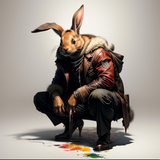

There’s a long-running, well-worn debate in writing circles about “Planner” versus “Discovery Writer.” You’ve probably seen it. Flowcharts. Twitter threads. Knives.
Naturally, I'm going to do what any unqualified noob would do and open my mouth when I have no right to.
In truth, I don’t like either label, so I’m going to rename them. From here on out, we’re calling them the Tactician and the Gunslinger. Catchier. More accurate. Objectively better. This is not up for discussion.
What I actually want to talk about, though, isn’t which one is “better.” It’s why I think the difference between these two writing styles isn’t nearly as meaningful as people think.
The Gunslinger
What people usually call a “Discovery Writer” is what I’m going to call a Gunslinger. Partly because it sounds cooler, but mostly because it’s a better description of what’s actually happening.
A Gunslinger doesn’t stand at the edge of the battlefield with a map and a clipboard. They kick the door in and start shooting. They write their way into the story, discovering characters, plot turns, and emotional beats directly in prose. The plan, such as it is, lives inside the act of writing itself.
They look at a blank page and say, "I'm your huckleberry." Then they let it rip.
That approach has real strengths. Voice and tone often come alive quickly. Things feel organic because they’re being discovered the same way a reader experiences them. There’s also a more romantic aura to writing this way, although that is a bit subjective.
In the end, the Gunslinger writes by momentum, intuition, and confidence—and accepts the chaos up front in exchange for immediacy and surprise.
The Tactician
What people usually call a “Planner” is what I’m going to call a Tactician. Not only does "planning" sound boring, but to me what they’re really doing isn’t planning so much as preparing a battlefield.
A Tactician doesn’t start with prose. They start with structure. Outlines. Diagrams. Notes. Character documents. Timelines. They want to understand the terrain before the first shot is fired. Where the choke points are. Where an ambush might happen. Which hills to take first and where to make the phase lines.
This isn’t about control for control’s sake. It’s about foresight.
A Tactician wants to know how the story ends before deciding how it begins. They want to understand the major reveals, reversals, and consequences early so those moments can be set up deliberately instead of accidentally. The writing happens later, but the thinking happens up front.
That’s why “planner” never quite fit for me. Planning sounds administrative. Like you're merely scheduling on a calendar. The Tactician, on the other hand, is actively shaping the fight before it happens—choosing where pressure will be applied and where space will be left open.
Sun Tzu famously wrote that every battle is won before it’s fought. That idea maps cleanly onto this approach. The goal isn’t to remove uncertainty entirely—that’s impossible—but to reduce chaos where it matters most. By the time the prose starts, many of the hardest decisions have already been made.
This all means that the Tactician enters the writing phase with confidence, clarity, and a strong sense of where every major move is headed so they can focus on things like character voicing and dialogue.
The Difference
The first thing worth saying is these methods aren't a binary choice. Writers don’t permanently belong to one camp or the other. Most of us move back and forth over time—sometimes even from book to book. Some writers live closer to the edges, sure, but most exist somewhere in the middle whether they admit it or not.
That’s where most discussions on this topic stop. And that’s where I want to throw the whole thing out and start over.
Because I don’t actually believe there’s a meaningful difference in what Gunslingers and Tacticians are doing. They’re both planning the novel. The difference is simply the deliverable they have at the end of the planning phase.
A Gunslinger’s plan is written in prose. They explore the story by drafting scenes, following characters, and discovering structure while the words are flowing onto the page. By the time they reach the end of a first draft, they are merely delivering a plan to build on in later drafts.
A Tactician, on the other hand, externalizes that same process. But their planning stage produces outlines, diagrams, summaries, and documents that describe the story instead. In other words, they iterate on structure, pacing, and reveals without committing to prose.
The important part is this: both writers have already written the story before they move on.
When a Tactician sits down to write what is technically their “first draft,” they’re often executing a version of the story that’s already gone through multiple iterations in planning. Meanwhile, when a Gunslinger finishes their first draft and moves into revision, they’re doing much of that same structural work—just later, and inside the prose itself.
So by the end of what I think of as Stage Two of the process—the point where the story actually exists in a coherent, end-to-end form—a Tactician’s first draft and a Gunslinger’s second draft are usually on roughly equal footing.
The paths were different, but the distance traveled was about the same.
Drawbacks of Both
Every approach breaks down somewhere. Not because it’s wrong, but because it’s being pushed past the point where it works best.
The Gunslinger’s failure mode usually shows up as narrative drift and structure issues. When you’re discovering the story in prose, it’s easy for threads to wander or for big moments to arrive without the fullest impact they could have. Complex reveals, layered secrets, and carefully staged emotional payoffs are hard to retrofit after the fact. Digging through prose to thread those things in later is tedious at best and destructive at worst.
For me, that kind of late-stage rework is exhausting and painful in a way only writers (and software engineers) truly understand. Prose and code can be fragile. Fixing one problem often creates two more, which leads to another revision, and then another.
Conversely, the Tactician’s failure is that planning can become a comfortable loop. There’s always one more edge case to account for, one more plot point to refine, one more woldbuilding nugget to polish. At some point, preparation turns into avoidance. The truth is, there’s a line where you just have to start writing, even though you know the plan isn’t perfect.
Because it never will be.
No matter how carefully you prepare, things will jump out of the drafting process that you couldn’t have predicted. Characters surprise you. Scenes bend in unexpected directions. Locking down every detail too tightly is often wasted effort, because some of those details are going to change anyway.
This is why neither approach is superior. Each one fails in a predictable way when it’s pushed too far. The trick is knowing yourself and how to stop pushing when you reach that limit.
Why I Am Firmly a Tactician
I’m firmly in the Tactician camp, and I’ve stopped pretending otherwise. My planning stage is expansive by design. Before I write a single line of prose, I build the novel out in other forms: detailed summary documents, a story-wide diagram that looks suspiciously like a software UML chart, character sheets, worldbuilding notes, and full chapter outlines from beginning to end.
At some point I’ll write a more detailed breakdown of that process—tentatively titled How I Plan My Novels—but the short version is that I want to know the battlefield before I fight.
The reason isn’t control. It’s iteration and efficiency.
Any time you try to build a complex system all at once, you’re asking for trouble. Software, infrastructure, organizations—none of them survive being designed and executed simultaneously. A novel, at least the kind I’m interested in writing, is no different. Planning and diagramming first lets me iterate quickly and cheaply on the story itself, without tearing through finished prose every time something needs to change. In fact, by the time I start writing prose, I've already "written" the story three times. It just looks like a diagram of plot point descriptions, rather than a novel.
I imagine that level of preparation isn’t as critical for straightforward novels with a single point of view and a clean narrative arc. But once you introduce multiple POVs, branching narratives, layered secrets, and delayed reveals, the margin for error gets thin fast. I can’t imagine trying to make all of that not only work, but land with maximum impact, if I were discovering it line by line and then performing archaeology on the prose later to fix what broke.
For me, this approach isn’t about organization for its own sake. It’s about payoff. The big moments only land if they’ve been set up properly, and that setup often spans the entire book. Planning lets me see those arcs early, adjust them deliberately, and make sure the reveals hit as hard as they can when the time comes.
The writing still surprises me. Things still change. But by the time I start drafting, I’m not guessing at where I’m going. I’m executing a plan that’s already been tested, revised, and refined.
Conclusion
At the end of the day, the Tactician and the Gunslinger are just two ways of approaching the same problem. Different tools. Different timing. The same underlying work. What matters isn’t which label you wear, but whether the approach you’re using fits both you and the story you’re trying to tell.
If you’ve found yourself somewhere along that spectrum—or drifting back and forth between the two—I’d be curious to hear how it’s worked for you. Feel free to share your thoughts in the comments.
And if you want updates on future posts, behind-the-scenes process notes, or extra writing-related content that doesn’t fit neatly into a blog post, you can join the newsletter below. No tactics required. Guns optional.


